
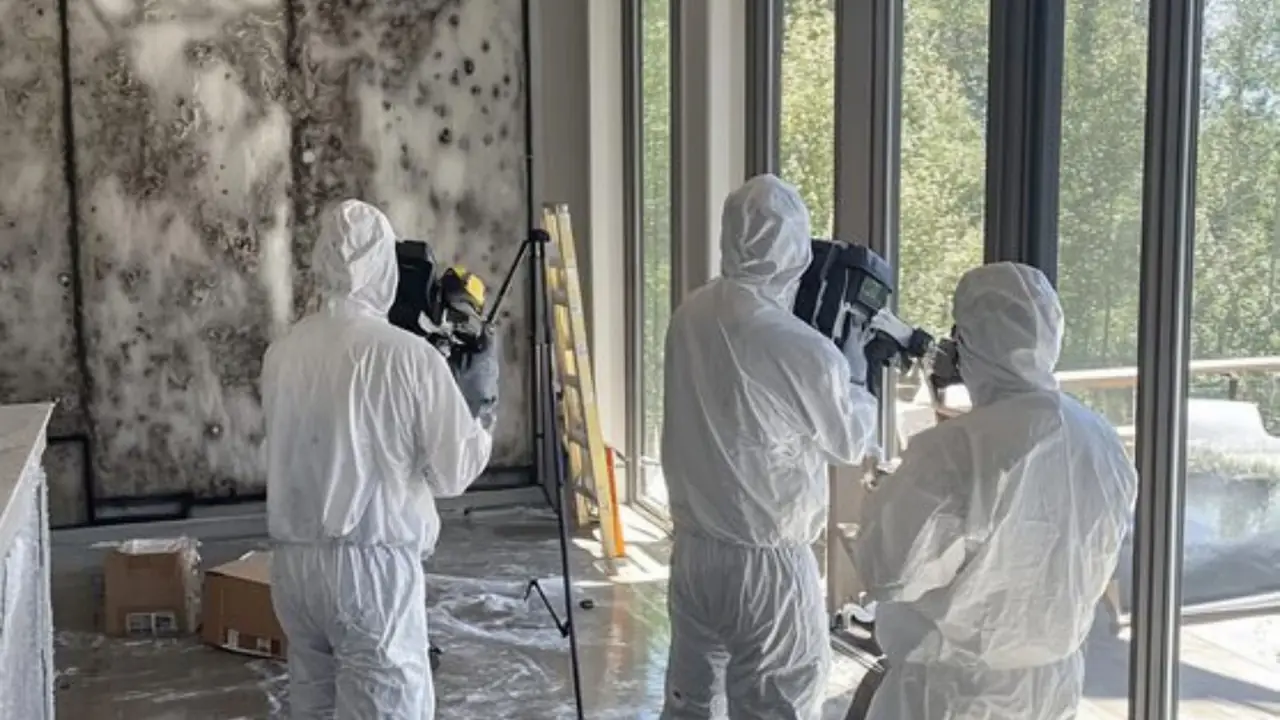
Here is the honest picture of hiring mold removal services in Massachusetts: nobody checks credentials for you. The state homeowner guide says no license is required to conduct mold remediation, so the quality of the job depends on what the company does, documents and puts in writing. This page walks through what a proper job looks like and what to ask before you sign.
If you have visible growth after a leak, call (978) 252-8637. Dispatch is open 24/7 and can explain how inspection and scope work.
Start with the moisture, not the mold
Mold grows where materials stay wet. A company that offers to remove mold without asking where the water came from is selling half a job. Before any cutting begins, the source has to be found and fixed, whether it is a roof leak, a sink drain, a basement seep or a condensation problem.
Inspectors use a moisture meter and a thermal imaging camera to read walls, ceilings and subfloors. They also look at what the mold is growing on, because material decides the method. Surface growth on tile is a cleaning job. Growth through drywall, insulation or carpet pad is a removal job.
The written scope
A real scope is a document, not a sentence on a text message. It should list the rooms and areas involved, the materials to be removed, the containment plan, the drying plan and what the finished condition will be. It should say what is not included, such as rebuilding, paint or the plumbing repair that caused the problem.
Ask for it before work begins. Scope and price should be explained before work starts, and if the number changes mid-job there should be a reason in writing, such as hidden growth found when a wall was opened. Reputable companies do not ask you to approve work verbally and sort out the paperwork later.
What happens on the job
Mold remediation practice is described in the ANSI/IICRC S520 standard for professional mold remediation. Ask whether crews work to it. The sequence below is the usual shape of a job.
- Inspect and set the scope.Moisture readings, photographs and a plan for what stays and what goes.
- Contain.Plastic barriers seal off the work area, and negative air machines with HEPA filtration pull air out so spores do not drift into clean rooms.
- Remove.Moldy porous materials such as drywall and insulation are cut out, bagged and carried out. Framing is cleaned with HEPA vacuums and damp wiping.
- Dry.Air movers and dehumidifiers bring the area to a dry standard, and readings are recorded.
- Verify.A visual check comes first. If you want independent results, a separate tester can sample after the work.
Containment is the line that separates a real job from a spray-and-wipe. If a crew shows up with a bottle and no barriers for anything larger than a small spot, ask why.
Water still spreading or mold already showing? Dispatch is open around the clock.
(978) 252-8637Clearance and who should test
Clearance is the check at the end that the work met the target set at the start. The simplest form is a visual inspection. For lenders, buyers or personal confidence, a third party can take air or surface samples. Independent testers are separate from the removal company, which avoids a conflict of interest.
This page does not promise that any lender or buyer will accept a given result, so ask what they require. No company can promise that mold will not come back either. Mold returns when moisture does, which is why the dry finish and the leak repair matter more than any product.
Questions to ask and red flags
Use the table as a checklist when you compare companies.
| Ask or watch for | What a good answer looks like |
|---|---|
| Do you work to ANSI/IICRC S520? | Yes, and they can explain how |
| What will you document? | Photos, moisture readings, a written scope and a drying log |
| How will you contain the area? | Barriers, negative air and HEPA filtration |
| What happens to the leak? | They identify the source and say who fixes it |
| Who does the testing? | An independent tester if you want separate results |
| Pressure to sign immediately | Red flag |
| A blanket treatment with no removal | Red flag for porous materials |
| Promises that mold will never return | Red flag |
| No written scope or no price discussion | Red flag |
Because the state does not license the work, references, insurance and written documents are the practical test. Ask for proof of insurance. Licensed and insured restoration professionals will give it without friction.
What drives the cost
Cost follows the size of the job and the materials. The area affected, the type of material, the containment and air filtration needed, the number of drying days and the rebuild scope after removal all move the price. A mold job after a long hidden leak usually costs more than a small spot found early.
Rebuild is priced separately from removal, which is why a good scope draws a line between the two. For the rebuild stage see our water damage repair page, and for drying help see water mitigation.
Mold coverage varies by policy. Some cover mold only when it follows a covered water loss, and some limit or exclude it. Check your policy and ask your insurer. Questions about health effects belong with a physician.
Amesbury local note: licenses, lead rules and permits
Massachusetts does not license mold remediation, according to the state homeowner guide, so the company's own standards and documents are what you are buying. Ask how it works, what it records and who will be at the property, then compare two or three written scopes before choosing.
If your house was built before 1978, the federal EPA RRP rule says paid work that disturbs paint needs EPA lead-safe certified firms. Cutting out painted plaster or trim on an older Amesbury house can fall under that rule, so ask any contractor how they handle it before demolition starts.
Rebuilding after removal can involve permits. Inspectional Services in Amesbury, at 39 S Hunt Road, takes permit applications online only, and the city page does not say if mold or water damage repairs need one, so ask before work begins.
Mold removal questions
How do I know if a mold removal company is qualified?
Massachusetts has no license for mold remediation, so ask about ANSI/IICRC S520, proof of insurance, a written scope and what they document. A qualified company answers directly and puts the plan in writing.
Should the company that removes the mold also test it?
It is better to have an independent tester do clearance sampling. Separate firms avoid the appearance of grading your own work, and you get results you can show a lender or buyer.
Can mold be removed in one day?
Small jobs sometimes are, but larger ones involve containment, removal and several days of drying. A same-day visit usually means inspection and scope, not a finished job.
Do I need to leave my house during mold removal?
It depends on the size and location of the work. Questions about health and who should stay out belong with your physician, and the crew can explain how containment separates the work area.
Do I have to pull a permit for work after mold removal in Amesbury?
The city page does not say. Ask Inspectional Services, where permits are filed online, before any rebuilding such as drywall or flooring begins.
Anyone dealing with a musty room in Amesbury can call the 24/7 line at (978) 252-8637 to ask how an inspection works. The same crews serve Salisbury and Merrimac, and the full service is described on our mold remediation page.