
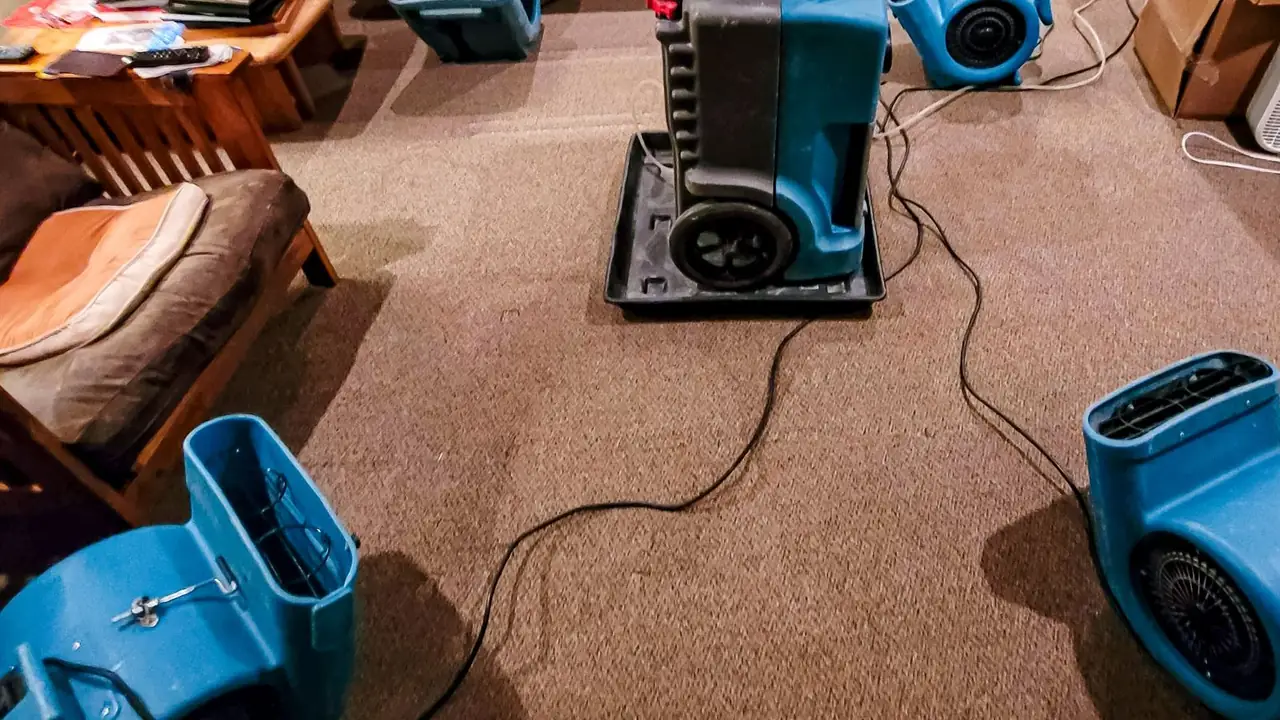
Structural drying is the controlled removal of water from the building itself, meaning framing, subfloor, drywall, plaster and masonry, using air movers, dehumidifiers and moisture readings. Extracting standing water is only the first stage. The materials still hold moisture long after the floor looks dry.
If your building took on water and the walls or floors still feel damp, call (978) 252-8637. Dispatch is open 24/7.
Where structural drying fits
Water loss work has stages, and drying sits in the middle. Crews first stop the source and extract standing water, then dry what remains, then clean and rebuild. Structural drying is the heart of water mitigation, and it decides whether materials are saved or torn out.
The approach follows ANSI/IICRC S500, the published standard for water damage restoration. It sets out how to classify water, assess materials and monitor drying. Ask any company you call whether its crews work to S500 and whether you can see the moisture log.
The equipment crews use
Each tool has a job. Together they move water from wet material into the air and out of the building.
| Equipment | What it does |
|---|---|
| Extraction unit and wet vacuum | Removes standing water from floors and carpet |
| Moisture meter | Reads moisture content in wood, drywall and masonry |
| Thermal camera | Shows cool, wet areas behind surfaces |
| Air mover | Pushes air across surfaces and into cavities |
| LGR dehumidifier | Pulls moisture from the air so it does not resettle |
| Desiccant dehumidifier | Works in cold or very damp conditions |
| Injection or mat system | Dries wall cavities or hardwood without full removal |
Placement matters as much as count. Air movers are aimed to create a flow through the whole affected zone, and dehumidifiers are sized to the volume of the air being dried.
How the process runs
A drying job follows a clear path from first visit to equipment pickup.
- Assess and map.A meter and thermal camera mark every wet area and set baseline readings.
- Remove what cannot dry.Saturated carpet pad, wet insulation and damaged drywall come out.
- Set equipment.Air movers and dehumidifiers are placed to move air through wet cavities and across surfaces.
- Monitor daily.Crews return, record temperature, humidity and moisture readings, and move equipment as the wet zone shrinks.
- Verify and remove.Equipment goes only when the materials match a dry reference reading from unaffected parts of the building.
Water still spreading or mold already showing? Dispatch is open around the clock.
(978) 252-8637How long structural drying takes
Most jobs run several days. Light damage to drywall may dry in three or four days, while hardwood, plaster and thick insulation take longer. Wet masonry can need more than a week.
The number depends on four things: how wet the materials got, what they are made of, how fast drying began, and how well the equipment controls humidity. A job that starts within a day or two moves faster than one that sat for a week. Stopping early because the room feels dry is how hidden moisture turns into mold later.
How readings decide the job is done
Dry is a number. On day one the crew takes readings of wet and unaffected materials, and the unaffected material becomes the dry standard for that building. Each day the wet readings are compared with it.
When wet areas match the reference, drying is complete. If a reading stalls, the crew adjusts equipment, opens another cavity or checks for a hidden source. This is why a written moisture log is the best proof that drying was done properly. It also gives your adjuster something concrete to review.
Why masonry basements dry slower
Stone, brick and concrete block absorb water and release it slowly. A thick foundation wall can hold moisture deep inside long after the surface feels dry, and basements are cool, which slows evaporation. Dehumidifiers and air movers still work, but the timeline is longer and monitoring visits are more frequent.
Heat can help in some cases, but pushing it too hard can crack old mortar or plaster. Crews often use desiccant dehumidifiers in cold basements because they work at lower temperatures than refrigerant units. Expect readings to be taken at different depths of the wall.
What affects the cost
Drying cost scales with equipment days and the work around them. Scope and price are explained before work starts.
| Cost factor | How it changes the job |
|---|---|
| Water category | Contaminated water means removal of porous materials |
| Affected area and volume | More space needs more air movers and dehumidifiers |
| Materials | Masonry, plaster and hardwood need more drying days |
| Drying days | Equipment is monitored until readings reach a dry standard |
| Rebuild scope | Repairs follow drying and are priced separately |
Insurance basics
Sudden and accidental water damage, such as a burst pipe, is often covered by a homeowners policy, while gradual leaks often are not. Flood needs separate flood coverage. Check your policy and ask your insurer, and keep the moisture log and photographs.
Amesbury local note: old foundations and wet years
A state housing plan citing American Community Survey data lists 35 percent of Amesbury's housing units as built before 1940. Many of those buildings have stone or brick foundations, and the takeaway is practical: expect a longer drying schedule and more monitoring visits in a basement of that kind.
The Boston area averages 43.59 inches of precipitation a year, according to National Weather Service 1991 to 2020 normals. That moisture reaches foundations every year, so a basement that was damp before a leak will take longer to reach a dry standard. Ask the crew to record readings before and after, so you know what normal looks like for your building.
The Massachusetts Housing Code requires leaks and floods to be dried within 48 hours. That is a fast benchmark for landlords, so call early.
Nearby, Newburyport and Haverhill also have older buildings with thick walls, and the same drying principles hold. After the structure is dry, water damage cleanup handles debris and odor.
Structural drying questions
How do I know my house is dry?
Ask for the moisture log. A building is dry when wet materials read the same as a dry reference reading from unaffected material in the same building.
Can I dry a house with box fans?
Fans move air but do not remove moisture from it. Without a dehumidifier and readings, water can settle back into drywall and framing.
Will drying equipment raise my electric bill?
Yes, running air movers and dehumidifiers uses power. Ask the crew how many units will run and for how many days so you can plan.
Is structural drying covered by insurance?
Often when the damage was sudden and accidental, but coverage depends on your policy. Check it and ask your insurer.
Why does my Amesbury stone basement take longer to dry?
Thick stone and brick hold water deep and basements stay cool. Many older Amesbury buildings fit this, so expect more monitoring days.
For a wet basement or wall that will not dry on its own, the 24/7 line at (978) 252-8637 can start the process.