
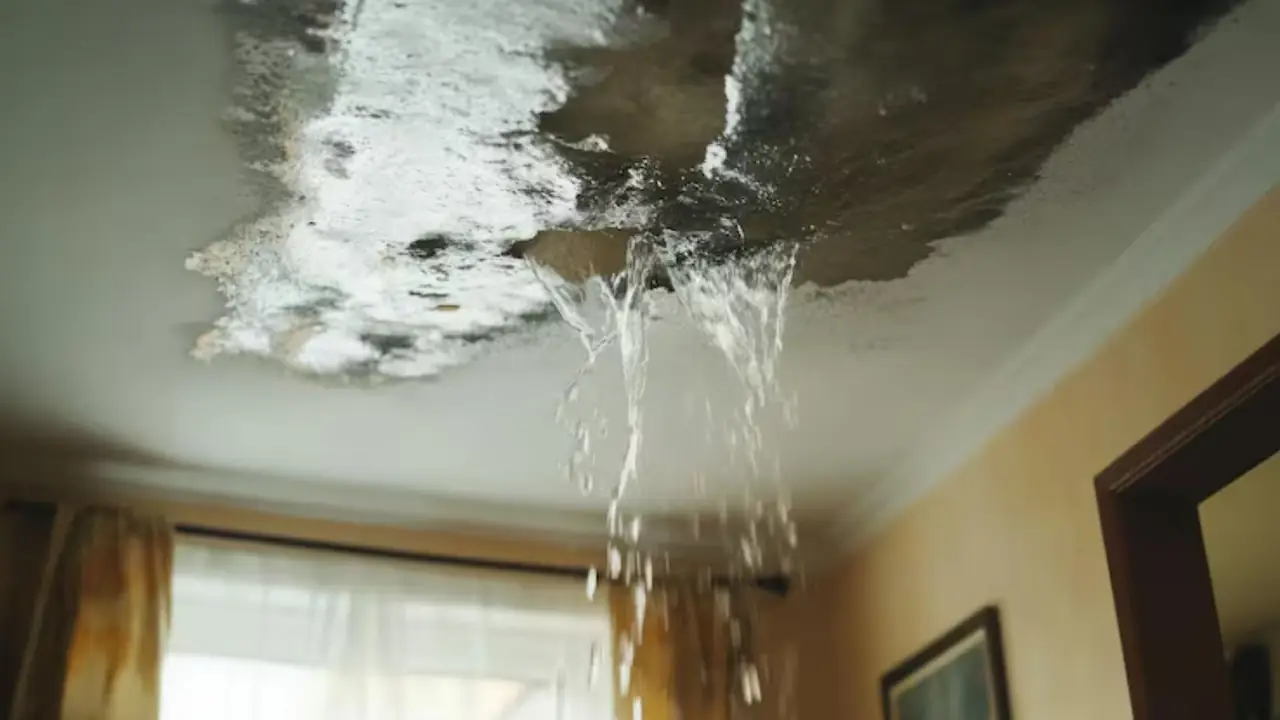
Sometimes yes. A flat brown stain that is dry to the touch is usually an old problem. A ceiling that sags, bulges, drips or sits under a light fixture is a different story, because wet drywall and plaster are heavy and can drop without warning.
If you see any of those signs, leave the room and keep people and pets out from underneath it. Call (978) 252-8637 and describe what you see. Dispatch is open 24/7.
Read the ceiling before you act
The way the ceiling looks tells you how urgent it is. Use this table to sort what you see.
| What you see | How serious | What to do |
|---|---|---|
| Dry yellow or brown ring | Old or inactive leak | Find the source, schedule an inspection |
| Damp stain that is growing | Active leak | Stop the water, call soon |
| Sagging or bulging drywall | Possible collapse | Stay out, call right away |
| Dripping or running water | Active leak with load above | Stay out, call right away |
| Water at a light fixture or fan | Electrical risk | Stay out, shut power at the panel only if it is dry and safe |
| Peeling paint and a musty smell | Prolonged moisture | Call for moisture mapping |
When you cannot tell, treat it as the more serious row.
Why a wet ceiling can fall
Drywall is gypsum between paper. When it soaks, it loses most of its strength and gains weight, and the water has nowhere to go because it pools in the cavity above. Plaster ceilings with lath behave similarly, and old plaster keys can let go in a sheet.
The risk is greatest when a bulge forms, since that bulge is a pocket of water held by wet paper. Insulation above holds even more. A sudden drop can bring water, insulation and debris down at once, and people are most often hurt standing or walking directly underneath.
Electrical danger from wet ceilings
Wiring, junction boxes and recessed lights sit in the same cavity the water is filling. Water can run along a cable and show up at a fixture far from the leak. Do not flip a switch for a light in a wet ceiling, and do not touch a fixture with water around it.
Shut off the circuit at the breaker only if you can reach the panel on dry floor and the panel itself is dry. If you are unsure, stay out and call. Electrical work after water damage is handled by a licensed electrician, and a restoration crew will tell you when one is needed.
Water still spreading or mold already showing? Dispatch is open around the clock.
(978) 252-8637What to do in the first hour
Quick, calm steps matter more than clever ones.
- Get out from under it.Clear the room, close the door and keep pets and children away.
- Stop the water source.If it is a bathroom or a supply line above, shut that fixture off or close the main interior shutoff.
- Protect what you can.Move furniture and electronics out only if you can do so without standing under the damage.
- Photograph first.Take pictures and short video of the ceiling, the stain and the room before anything is moved.
- Call right away.Tell dispatch whether it is sagging, dripping or near a light.
Do not poke or cut into a bulging ceiling yourself. A trained crew can release trapped water in a controlled way with the room set up for it, and that is a job for professionals.
Common causes of ceiling leaks
Plumbing above is the usual cause. A second-floor bathroom supply line, a tub overflow or a failed wax ring can send water down through the floor system. Roof leaks, clogged gutters and failed flashing are the others. Condensation from an air handler or a poorly vented attic can also stain a ceiling over time.
Water often travels along a joist before it shows itself, so the stain may sit several feet from the true source. That is why a moisture meter and thermal camera are used to trace it before anyone opens the ceiling.
What affects the cost
The price of a ceiling job depends mostly on how much is wet and what is above it. Scope and price are explained before work starts.
| Cost factor | How it changes the job |
|---|---|
| Water category | Roof or sewage-related water means removal, not drying |
| Area affected | Larger ceilings need more openings and equipment |
| Materials | Plaster and drywall are handled differently |
| Drying days | Insulation and framing above take time to dry |
| Rebuild scope | New drywall, texture and paint are priced after the structure is dry |
After the cavity is dry, rebuilding the ceiling is covered under water damage repair. Active or heavy flows are urgent enough to fall under emergency water removal.
Amesbury local note: winter ceilings
The Boston area averages 91.6 days a year with a low at or below 32 degrees, according to National Weather Service 1991 to 2020 normals. Freezing and thawing is how ice dams and roof leaks start, and a roof leak often first shows up as a ceiling stain. After a cold snap, check your upstairs ceilings and attic edges so a small leak is found early.
The Massachusetts Division of Insurance notes that a burst pipe is usually a homeowners claim when it is sudden and accidental. Photographs taken before anything moves help your claim, so take them before you start tearing out wet drywall. Check your policy and ask your insurer about roof and ice dam coverage.
If the leak came from a roof or exterior wall and you live near Merrimac or West Newbury, the same first-hour steps apply there.
Water damaged ceiling questions
Should I puncture a bulging ceiling to let the water out?
No. A bulge is held water, and cutting it open releases it onto you and the floor. Stay out from under it and call so a crew can handle it safely.
Can a stained ceiling be painted over?
Only after the source is fixed and the material is dry. Paint over a wet ceiling traps moisture and the stain often comes back.
How long can a ceiling stay wet before mold grows?
Mold can begin within a day or two in a warm, closed cavity. The Massachusetts homeowner guide says to dry wet areas within 24 hours, so move quickly.
Is a water damaged ceiling covered by insurance?
Often when the cause was sudden and accidental, such as a burst pipe. Gradual leaks often are not covered. Check your policy and ask your insurer.
Why do Amesbury ceilings leak after a cold snap?
Freezing weather can cause ice dams and cracked pipes, and thawing sends water into the roof or ceiling. Amesbury's Boston-area winter averages 91.6 freezing days a year.
If a ceiling in your home is sagging or dripping, the 24/7 line at (978) 252-8637 is where to turn once you are safely out of the room.